

The success of presentation AI in your organization is not determined by the tool you choose. It depends on whether you have established seven key requirements: a clear use case, defined governance, secure data access, clear responsibilities, the right user group, measurable success criteria, and a model for scaling.
This article will help you determine whether your organization is ready to use presentation AI productively, securely, and at scale, regardless of whether your PowerPoint templates, slide libraries, or existing content are already AI-ready.
Presentation AI readiness is ultimately about creating the organizational foundation that allows presentation AI to be used in a targeted, secure, and measurable way.
1. Without a clear use case, presentation AI has limited value
2. Governance determines whether presentation AI can scale responsibly
3. Security readiness means AI can access only what it needs
4. Without clear ownership, presentation AI remains a pilot
5. The right user group determines adoption and value
6. Without success criteria, AI readiness remains a gut feeling
7. Scalability comes from operational readiness, not more licenses
1. Without a clear use case, presentation AI has limited value
Start with a simple question: What business problem should presentation AI solve for us rather than which presentation AI tool do we want to use?
Potential goals include:
- Creating sales presentations faster
- Preparing management reports more efficiently
- Making knowledge from multiple sources easier to access and use
- Standardizing recurring presentation processes
- Reducing the workload involved in creating customized materials
A strong use case does more than state that presentations should be created faster. It defines the team involved, the process in which AI will be used, the required approvals, and the measurable outcome.
Instead of saying, "We want to create presentations with AI," a more specific goal might be: Our sales team should be able to create first drafts of pitch presentations faster without bypassing quality or approval standards.
If several AI use cases are possible, evaluate them based on business value, feasibility, and risk. A simple prioritization framework asks three questions:
-
Value: Does the use case measurably save time, reduce coordination effort, or improve the quality of important presentations?
-
Feasibility: Are the process, user group, data access, and approval paths clear enough to test the use case realistically?
-
Risk: Does the use case involve sensitive data, external recipients, regulatory requirements, or business-critical decisions?
Recurring presentation processes with significant manual effort and clearly measurable opportunities for improvement are particularly well suited for an initial deployment.
2. Governance determines whether presentation AI can scale responsibly
Once the use case is defined, employees need clear guidelines.
They should not have to determine on their own which data they may use, when approval is required, or which types of content require mandatory human review.
Before deployment, clarify:
- Which presentations may be created with AI?
- What information may be processed?
- When is human review mandatory?
- Which content requires additional approval?
- Which tools and vendors are approved?
- How will important decisions be documented?
Your organization is AI-ready when employees understand what is permitted, where the boundaries are, and who makes the final decision when questions arise.
Established AI governance frameworks address these issues as well. The NIST AI Risk Management Framework treats governance as a foundation for managing AI risks throughout the AI lifecycle. ISO/IEC 42001 describes a management system that organizations can use to establish policies, responsibilities, and processes for AI.
3. Security readiness means AI can access only what it needs
Presentations often contain sensitive information, including customer data, financial figures, strategies, roadmaps, and personal information.
Organizations therefore need to answer a fundamental question: Which information may each AI system process, and in what context?
This includes:
- Rules for confidential company and customer data
- Roles and access permissions
- Requirements for external AI tools
- Logging and monitoring
- Data privacy and compliance requirements
Organizations should also address existing access-control issues. If employees currently have access to information they do not actually need, AI can amplify this oversharing.
This is particularly important for AI systems that access company data directly. Microsoft also addresses the risks associated with oversharing and sensitive information in connection with Copilot deployments, along with the need for appropriate governance controls.
Security readiness therefore means controlling not only the AI tool, but also more importantly: Who and what that tool can access.

4. Without clear ownership, presentation AI remains a pilot
Who is responsible for presentation AI in your organization? If the answer is "Marketing, IT, Sales, and Legal together," there is often no clear owner.
Define responsibilities early and make clear who has decision-making authority. Depending on the organization, responsibilities may include:
- A business owner responsible for the use case and priorities
- IT responsible for integration and operations
- Security and Compliance responsible for risk requirements
- Brand or Marketing responsible for quality standards
- Business teams responsible for specific use cases
- Enablement or Operations responsible for deployment and training
You do not necessarily need a large AI committee. You do need clear ownership and accountability.
If you want to prepare your use case for internal review or approval, our “Preparing an AI Presentation Project” checklist helps you organize the key information decision-makers need.
An organization is not ready for deployment if no one can determine whether an AI-generated customer presentation must be reviewed by Legal, Sales Enablement, Brand, or the account owner before it is sent.
Without clear ownership, departments ultimately make their own decisions. This can lead to uncontrolled tool adoption, inconsistent quality standards, and unnecessary risk.
5. The right user group determines adoption and value
Do not deploy presentation AI across the entire organization immediately. Start with a user group where you can identify and measure the value quickly.
Potential groups include:
- Sales
- Consulting
- Marketing
- Customer Success
- HR and Learing
- Product Management
The department itself is less important than the workflow.
Choose a group that creates presentations frequently, follows a recurring process, and currently spends significant time on presentation creation or coordination.
6. Without success criteria, AI readiness remains a gut feeling
A pilot can work technically and still deliver limited business value. Before the pilot begins, define how you will measure success.
Potential KPIs include:
- Time saved per presentation
- Shorter coordination and approval cycles
- Faster creation of sales or management materials
- Lower error rates
- Better adherence to defined processes
- Lower external design or agency costs
Choose metrics that directly support your use case. If your goal is to reduce the workload for your sales team, the number of slides generated is not particularly meaningful. Instead, measure how much time the team saves, how quickly materials become ready for use, and how much rework is still required.
Presentation AI is not successful simply because it generates more slides. It is successful when it helps teams create relevant presentations faster, more consistently, and with less effort.
In addition to these organizational requirements, assess how well your existing presentations, templates, and slide libraries can support AI use. Preparing this content, however, is a separate readiness step.
7. Scalability comes from operational readiness, not more licenses
A successful pilot is only the beginning. Once additional teams want to use the tool, you need a model for ongoing operations and support.
Clarify early:
- How will you onboard additional teams?
- Which processes will you standardize?
- Who will maintain the rules and training?
- How will you evaluate new use cases?
- How will you prevent multiple tools from being used for the same purpose?
- Where can users get support?
- How will feedback and lessons learned be incorporated into the process?
Scaling means being able to manage, operate, and continuously improve presentation AI over the long term. Only then does a successful pilot become a reliable enterprise standard.
Typical warning signs: When your organization is not yet ready
Your organization may not be sufficiently AI-ready if:
- The planned use is driven primarily by curiosity about the technology, but no specific business case has been defined
- Employees have to decide for themselves which data they are allowed to enter into AI tools
- No one is responsible for approvals, quality, and risk assessment
- Sensitive presentations could be sent to customers or external stakeholders without a clearly defined review process
- Success is measured only by the number of slides generated
- Multiple departments are testing different AI tools in parallel without shared rules or standards
These warning signs do not mean that presentation AI is unsuitable. They indicate that governance, ownership, and security should be addressed before broader deployment.
Successful presentation AI starts before tool selection
Presentation AI is becoming increasingly capable. Better technology, however, does not resolve organizational questions.
The tool does not define your most important use case. It does not determine which data may be processed. It does not assign responsibilities or determine when the investment will create sufficient business value. Those decisions are yours to make.
Once those requirements are clear, you can take a structured approach to evaluating your options. Our checklist of selection criteria for AI presentation tools helps you systematically compare different solutions with your company’s specific requirements.
If you can use presentation AI in a targeted, secure, and measurable way, your organization is AI-ready. That creates the foundation not only for a successful pilot, but also for sustainable, long-term use across the organization.
When you are ready to move from organizational preparation to implementation, see how empower® AI brings AI-powered slide creation directly into PowerPoint while using your company’s approved layouts and brand standards. 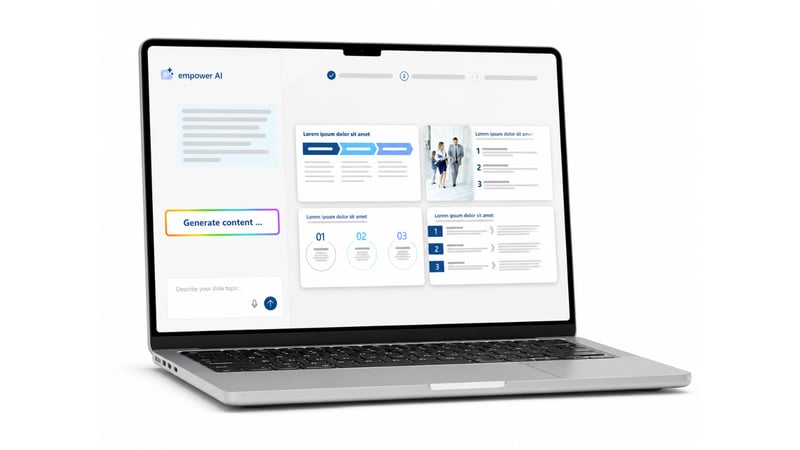
FAQ: AI readiness for presentation AI
What does AI readiness mean for an organization?
AI readiness means that an organization has established the strategic, organizational, technical, and regulatory conditions required to use AI safely, in a controlled manner, and in ways that create business value.
What does AI readiness mean for presentation AI?
For presentation AI, AI readiness means that the use case, governance, security, responsibilities, user groups, success criteria, and scaling approach have been defined before the technology is deployed broadly across the organization.
Why is presentation AI an organizational issue?
Presentation AI often affects existing workflows, approval processes, data access, brand standards, and communication processes. Simply selecting a tool is therefore not enough. Organizations must determine who will use the tool, what information may be processed, and who is responsible for reviewing the results.
What does AI readiness mean for an organization?
AI readiness means that an organization has established the strategic, organizational, technical, and regulatory conditions required to use AI safely, in a controlled manner, and in ways that create business value.
What is the difference between organizational AI readiness and template readiness?
Organizational AI readiness describes whether an organization can use presentation AI safely and effectively. Template readiness, by contrast, describes whether PowerPoint templates, slide libraries, and existing content have been prepared in a way that allows AI systems to use them effectively.

Creating PowerPoint presentations with AI: Why generated slides do not convince

How to prepare a presentation AI pilot – Introducing AI in organizations