


As companies roll out enterprise AI platforms such as ChatGPT, Claude, and Microsoft Copilot, new AI initiatives are taking shape across the organization. Teams are identifying use cases, building prototypes, and looking for ways to automate existing workflows.
One AI use case is especially appealing: automatically creating professional PowerPoint presentations from briefings, reports, or structured data for sales proposals, executive updates, or client meetings.
The first results can be impressive. A few prompts can produce usable slides in minutes. That often leads to an understandable conclusion: We can build this ourselves.
Technically, you can. But that is not the most important question. The real question is whether you want to build, operate, and continuously improve a reliable software product for years to come. Because there is a major difference between a prototype that generates good slides and a production-ready platform that employees can rely on every day.
Building internally can make sense when presentation generation is part of your own product, when your workflows are highly specialized, or when existing solutions cannot meet critical requirements.
In most other cases, it is worth looking carefully at the build-or-buy decision.
Is presentation technology really your competitive advantage?
Few companies build their own spreadsheet application, CRM platform, or office suite. Not because they could not do it, but because their engineering resources can usually create greater value elsewhere.
The same principle applies to AI-powered presentation software. High-quality presentations matter in sales, management, and corporate communications. But for most organizations, the technology used to create those presentations is not a core business capability.
If your developers could be improving your products, customer experience, or proprietary business processes, the question becomes straightforward. Why should they also build and maintain an internal presentation platform?
That is the essence of the build-or-buy decision. Just because you can build something does not mean building it is the best use of your resources.
Building the prototype is the easy part
Creating an initial demo of AI-generated presentations is relatively straightforward today. A large language model can analyze the source material, create a storyline, and draft slide content. APIs or software libraries can then turn that content into a PowerPoint file. For a proof of concept, this can work remarkably well.
Production is different. An enterprise-ready AI presentation solution must consistently
-
Follow your brand guidelines
-
Condense and structure information effectively
-
Turn tables, processes, comparisons, and metrics into appropriate visuals
-
Understand different presentation types
-
Work correctly with existing PowerPoint templates
-
Generate technically sound, fully editable files
-
Respect permissions and corporate policies
-
Connect to multiple data sources
-
Remain reliable when models and APIs change
Once these requirements enter the picture, you are no longer building a prototype.
You are building a software product. And software products require testing, quality assurance, monitoring, support, release management, and continuous development.
Great presentations require more than great prompts
Building effective presentation AI is not simply a matter of finding better ways to place text on slides. The system also has to understand how information should be communicated visually.
A trend over time might call for a timeline. A decision may be easier to understand as a comparison. A business workflow may need a process diagram. An executive update requires a concise, clearly prioritized summary.
The real challenge is not, “How do we get an LLM to write PowerPoint slides?” It is, “How do we reliably turn different types of information into presentations that are clear, visually appropriate, and consistent with our brand?”
That requires more than generative AI. It requires presentation logic, layout intelligence, visualization concepts, quality standards, guardrails, and a consistent user experience.
Those details determine whether your system occasionally creates an impressive deck or becomes a tool employees can depend on every day.
The biggest costs often come after launch
An internally developed solution can look inexpensive at first. Your organization may already license the AI platform you need. APIs are relatively easy to connect. A prototype may require only a few weeks of development.
But the initial build is only part of the cost. Models change. APIs evolve. Features are deprecated. New generations of models introduce new capabilities. At the same time, users expect the product to keep improving.
That creates an ongoing workload. Prompts and workflows need to be updated. New models need to be evaluated. Errors need to be investigated. Features need to be expanded. Existing outputs need to be regression-tested.
Model usage itself also creates costs. Complex, prompt-heavy workflows can consume substantial numbers of tokens.
A specialized system can approach the problem differently. Some tasks can be handled more efficiently through conventional software logic, predefined rules, or purpose-selected models. Generative AI can then be reserved for the steps where it actually adds value.
That is why an economic evaluation should look beyond the cost of the first prototype. The more meaningful metric is total cost of ownership over several years.
AI products never really stand still
Launching the product does not end the work. AI models continue to change. New models bring different capabilities, pricing structures, and technical options. Existing models are updated, replaced, or discontinued.
If you build your own presentation platform, your team will continually need to answer questions such as
-
Which model is best for each step of the workflow right now?
-
When is it worth switching models?
-
Which prompts and workflows still perform reliably?
-
Which new capabilities should be added?
-
Could a model change reduce the quality of presentations that previously worked well?
These are not one-time implementation questions. They become part of ongoing product management.
With a specialized AI presentation solution, the provider handles this work across the product. New models, improved workflows, and lessons from different customer scenarios can be incorporated centrally.
Your company benefits from that ongoing development without maintaining a dedicated internal presentation-technology team.

When building in-house AI solutions still makes sense
Building internally is not always the wrong choice. If presentation generation is a core part of your own product, controlling the underlying technology may be strategically important.
An internal solution may also make sense when you have highly specialized workflows, unusual data models, or technical requirements that existing products cannot support.
In those cases, the decision should be deliberate and should account for the full investment required across
-
Development
-
Operations
-
Maintenance
-
Quality assurance
-
Model management
-
Continuous product development
But if your main objective is simply to make presentation creation faster and more efficient, a different question becomes relevant.
Do you really need to build all of this expertise yourself?
When the specialized expertise already exists
A reliable AI presentation platform combines several disciplines. It needs AI expertise, software engineering, presentation logic, brand intelligence, and continuous product development.
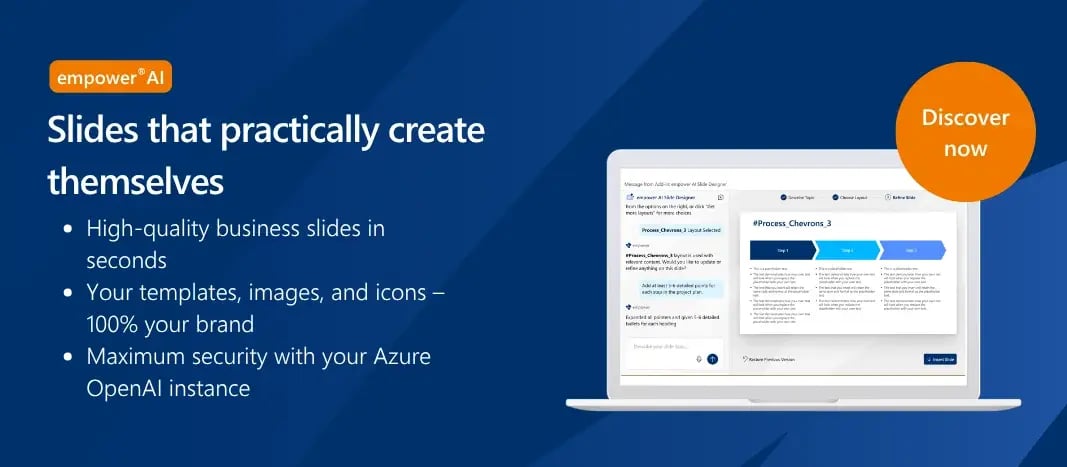
empower® AI combines generative AI with specialized software logic, presentation expertise, layout rules, and existing brand standards.
It also does not depend on a large language model for every step of the workflow. AI is used where it creates meaningful value. Tasks that can be handled more precisely or efficiently through specialized software logic are handled that way instead.
With an internal build, your organization would need to develop many of these capabilities from the ground up and continue improving them over time.
A specialized solution already has that expertise built into the product.
For companies, the benefit is simple: Your AI and engineering teams can stay focused on the technology and processes that actually differentiate your business.
Build or buy is ultimately a strategic decision
Modern AI models make it possible to build an impressive prototype for automated presentation creation surprisingly quickly.
But the prototype is only the beginning. The larger investment comes from quality assurance, brand consistency, visualization, integrations, maintenance, model changes, and continuous improvement.
That is why presentation AI deserves the same build-or-buy analysis as any other major software capability.
The question is not simply whether your organization can build it.
The question is whether you want to commit engineering resources to presentation technology for the long term. Or whether those resources can create more value elsewhere in your business.

Strong AI use case for companies: business presentations

Interbrand Report 2025 – Why brands will be chosen, not just found