


The idea is tempting. AI creates presentations fully automatically. Structure, content, slides, everything appears at the push of a button. A person gives it one quick review to preserve the feeling of control, then turns back to more important matters, such as wondering why no one actually implemented the last strategy project.
What looks like an efficiency gain is often something else entirely: a shift from visible effort to invisible irrelevance.
It feels like progress. Like relief. Like the chance to work more comfortably. But that is exactly where the danger lies. Convenience is an excellent accelerator, unfortunately, usually in the wrong direction. It reduces not only effort, but also attention. And attention is the one thing that truly makes presentations good. Everything else is decoration.
Agentic AI: When autonomy is promised while responsibility quietly leaves the room
This is where Agentic AI enters the stage.
It is a term that sounds as though someone put agency, autonomy, and initiative into a blender, then sprinkled “Enterprise” on top. It refers to AI that does not merely react, but acts independently, makes decisions, and operates with authority. At least until someone asks who is actually accountable.
More precisely, it refers to AI that does not simply execute tasks, but pursues goals, plans intermediate steps, uses tools, checks results, and iterates. In other words, it no longer waits for isolated commands. It acts on its own.
The problem is not autonomy itself. The problem is what often gets left out: authority to act is not a technical feature. It is a social construct. It is granted, not programmed. It exists only where responsibility is carried. And responsibility is something people are reluctant to automate, especially when it may later have to explain itself in a meeting.
Of course, AI makes decisions. It prioritizes, selects, and rejects. It can even justify those decisions. What it cannot do is guarantee that those justifications are anything more than plausible reconstructions. And that is the point.
Presentations intended to create impact need more than decisions. They need reasons that hold up in a social context. A point of view. Context. Originality. And, at times, the courage to be wrong without immediately supporting every claim with statistics.
empower® AI: Operational excellence meets strategic control
This is exactly where empower® AI comes in, with a fundamentally different approach from most AI presentation tools.
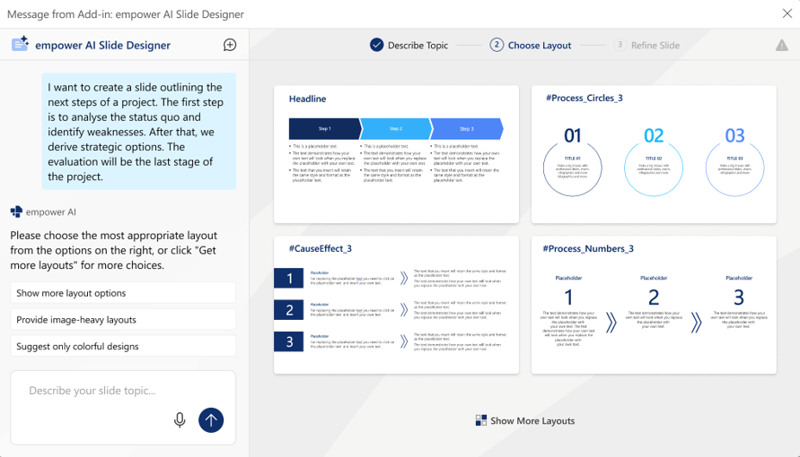
Instead of promising to “automatically create perfect presentations,” empower® AI takes over what AI is truly excellent at: brand-compliant layouts, clean visualization, and technical precision, directly in PowerPoint. It does this based on the existing corporate design the company already needs to use. No export into proprietary formats. No “almost like your brand guidelines” results. No formatting battle afterward.
In this collaboration, the human keeps full control over what truly matters: message, narrative, and sharpness. The human decides which argument belongs where, what gets left out, and where a risk needs to be taken. AI makes sure those decisions are executed with technical and visual brilliance, in seconds instead of hours.
Presentations as a place for the uncomfortable
Good presentations are not complete. They are selective. They are not balanced. They are pointed. And they are rarely comfortable, because they have to trigger change and create impact.
Their impact does not come from the amount of information they contain. It comes from the deliberate choice to leave something out. It comes from emphasis and from the targeted risk of being open to criticism. That is exactly what makes them valuable, and at the same time so exhausting for organizations.
Anyone who has ever been in a moment when a decision truly mattered knows this: the slides do not make the decision. The decision happens in the moment when someone senses that something real is being said. That genuine persuasion is happening. It also happens when a slide comes too early. Or too late. When an argument sticks, even though it has technically already been disproven. That is subtext. And subtext is what happens while, officially, no one is talking about it.
AI-generated presentations do not understand that moment. They show patterns, probabilities, and correlations. That is impressive and, in many contexts, extremely useful. But it does not replace situational understanding of why this exact argument is being made today, in this room, by this person. Probabilities are great, as long as no one has to stand behind the consequences.
The generic nature of completeness
That is why presentations primarily generated by AI are recognizable. Not because of their mistakes, but because of their generic quality. They are clean, logical, complete, and therefore completely harmless. They hurt no one, challenge no one, and risk nothing. They are as exciting as a package insert, only without the honest warning about possible side effects.
This is not a technical problem. It is a thinking problem. Decision-making work is treated like process work, and then people are surprised that everything has been said, yet no one is moved.
Where AI ends and responsibility begins
AI is excellent at everything repeatable. In this area, it is not only useful, but overdue. The real question is why we put ourselves through that work manually for so long.
It becomes problematic where meaning is created. In complex relationships. Individual contexts. Narrative tension and sharp strategic emphasis. In other words, exactly where presentations stop being information media and become instruments of influence.
The only approach that works is a clear division of labor. AI takes over the operational work. The human takes responsibility. Not as a matter of principle, but as a matter of necessity: AI does not answer for bad decisions.
empower® AI: Operational relief creates strategic space
empower® AI resolves this tension. It does not act as an autopilot. It acts as an accelerator. It removes the technical burden: formatting, alignment, and corporate design compliance, without taking over strategic responsibility.
What emerges is not automated generic content. It is time for what truly matters: strategic persuasion, time, and mental space. Space for prioritization. For narrative structure. For the question of what you actually want to say and what you deliberately do not.
Judgment cannot be delegated
In the end, one uncomfortable but solid insight remains: presentations intended to influence decisions require human judgment, courage, and timing. This is not a romantic idea. It is an empirical one. You can observe it every day, usually shortly before someone says the topic needs to be “taken offline.”
AI can dramatically shorten the path to a good presentation. The human still has to walk that path.
Everything else is not progress. It is merely accelerated irrelevance.

Creating PowerPoint presentations with AI: Why generated slides do not convince

AI meets presentations: When humans and machines collaborate