

Despite the growing excitement around artificial intelligence, Europe's CMOs are putting greater emphasis on branding, trust, and authenticity, according to McKinsey. The report highlights that while AI is recognized as a useful operational tool, the brand has become a strategic cornerstone.
Branding and authenticity take priority over AI
AI dominates today’s marketing conversations – from events to LinkedIn posts to strategy documents. Topics like automation, efficiency, and scale are front and center.
That’s why McKinsey’s “State of Marketing Europe 2026” report stands out. It reveals that CMOs across Europe are prioritizing branding, trust, and authenticity – well ahead of AI.
This shift carries a strategic message: As marketing becomes faster and more competitive, driven by AI, the need for a strong, stable brand grows more urgent.
This article unpacks the key insights from McKinsey’s report and explains why marketing leaders are returning to core brand principles.
Why brand still matters more than the hype
Published in 2025, McKinsey’s study surveyed 500 marketing executives from various sectors and company sizes across Europe. The aim was to identify which issues marketers consider most critical for future success.
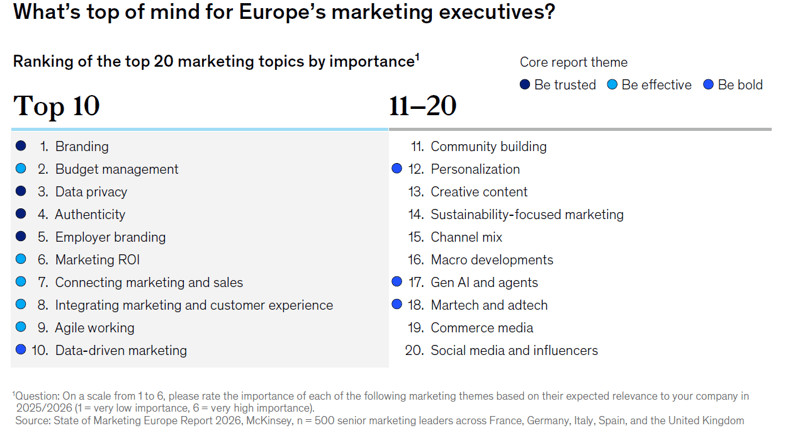
The findings challenge the public narrative. While AI is widely discussed, it ranks far below traditional marketing fundamentals in actual importance. The top priorities are:
- Branding
- Budget management
- Data privacy
- Authenticity
Generative AI and intelligent agents land at number 17 out of 20 – suggesting a conscious, strategic de-emphasis.
Why branding matters more now
In a fast-changing, algorithm-driven world, simply promoting product features isn’t enough. Brands must guide, build trust, and stay emotionally meaningful. Although this may seem surprising, it’s a logical reaction to recent trends. Marketing has been driven by:
- Performance metrics
- Efficiency and scale
- Automation through MarTech
- Short-term KPIs
AI fits this mold – faster, cheaper, more output. But that also creates a challenge.
When content becomes mass-produced, it loses distinctiveness. When messages become interchangeable, brands lose direction. CMOs are increasingly aware of this. In response, brand becomes a vital strategic compass.
Brand as the anchor in the AI age
The McKinsey report shows that marketers see authentic brand experiences as key to emotional engagement, differentiation, and long-term growth.
About 70% agree with statements such as:
- “Authenticity must be demonstrated.”
- “Purpose and mission are central to our communications.”
- “Brand experiences drive growth more than individual products or services.”
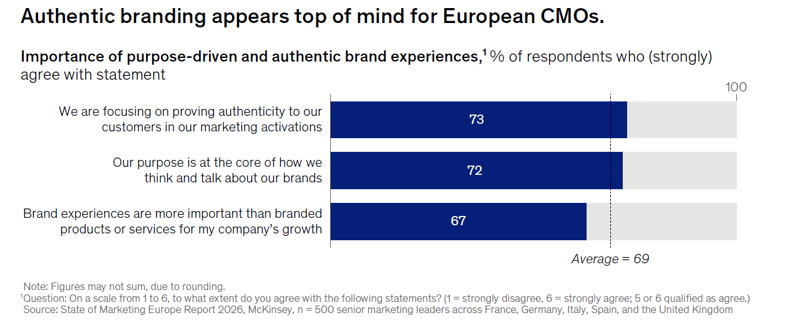
This signals a shift from isolated campaigns and tools to consistent brand experiences as growth drivers. In an AI-filtered world, trust is more important than ever – for both people and systems.
How is AI really being used in marketing?
AI is present in marketing, but its role is more limited than often portrayed. According to the report:
- It’s used in specific, experimental ways
- Its focus is on efficiency-related tasks
- Most companies don’t see themselves as mature in AI use
The impact of AI on business outcomes has so far been modest. McKinsey points to structural issues:
- Poor data quality
- Weak governance frameworks
- Limited workflow integration
- Uncertainty about effectiveness and ROI
AI supports marketing, but it isn’t yet a strategic driver. This makes branding even more crucial.

The takeaway: Brand leads, AI follows
As content becomes faster to create, personalize, and scale, these factors become essential:
- Consistency
- Recognition
- Trust
- Clear brand guidelines
AI can amplify effectiveness – but only when guided by a strong brand. Without clear brand leadership, AI scales sameness. In essence, AI magnifies what already exists. For better or worse.
empower’s Perspective
 “AI is transforming marketing rapidly, but it doesn’t replace what gives brands their strength. As everything speeds up and becomes more replaceable, a clear, consistent brand becomes essential,” says Felix Buller, Director of Marketing & Sales at Empower.
Our experience shows: If a brand isn’t clearly defined and understood internally, no technology – no matter how advanced – can improve its long-term impact.
Conclusion: Going back to basics is a strategic move
The State of Marketing Europe 2026 shows that European CMOs are thinking long-term and acting with strategic clarity – not rejecting technology, but reprioritizing. Brand provides direction. AI scales execution.
Now is the time for CMOs to:
- Lead brand strategy with intention
- Build internal clarity around values and purpose
- Apply AI within a well-defined brand framework
In 2026, the rule is clearer than ever: Without a strong brand, there’s no lasting impact. Regardless of how smart the tech may be.


Brand consistency in decentralized teams

Adhere to brand guidelines company-wide at the push of a button